Blue Lotus Archive
The history of Blue Lotus
in Ancient Egypt
Nymphaea caerulea — the Egyptian Blue Lotus — has one of the longest documented relationships with human spiritual practice of any plant on earth. Four thousand years of ritual use. Named in the oldest medical texts. Found preserved in royal tombs. This is its history.
The flower that opened Egypt's inner world
In Ancient Egypt, Nymphaea caerulea was not simply a beautiful flower. It was understood as a living embodiment of creation itself. Each morning, the Blue Lotus rises from the water at sunrise and closes again at sunset — a cycle so precise and so visible that the Egyptians built their solar mythology around it. The lotus was not a symbol of the sun. It was seen as the sun's physical counterpart on earth: the form the light takes when it touches water.
This is why the flower appears in every major context of Egyptian sacred life — in temple reliefs, in burial offerings, in medical papyri, in royal tombs. It was not decoration. It was the key that the Egyptians used to access what lies within.
"Before it was a flower, it was a key to what lies within."
Four thousand years of documented use: a chronology
The historical record of Nymphaea caerulea in Egypt is unusually complete — preserved by the dry climate of the Nile Valley and the Egyptian tradition of detailed inscription. The timeline below draws on archaeological and textual sources that can be independently verified.
Nymphaea caerulea appears in early Egyptian iconography as a symbol of creation and the primordial waters. The flower is associated with the emergence of the sun from the lotus at the beginning of time.
The Pyramid Texts, among the oldest religious writings ever discovered, reference the lotus as a symbol of rebirth and eternal life. The deceased pharaoh is described as rising from the lotus like the sun rises from the Nile.
The Ebers Papyrus — one of the oldest and most complete medical documents of the ancient world — includes references to the Blue Lotus alongside ritual and ceremonial preparations. This is one of the earliest written records of its intentional use.
The Blue Lotus reaches its height of ceremonial significance. Wall paintings at Karnak, Luxor, and Abydos show priests and nobles holding or inhaling the flower during ritual banquets and religious ceremonies. The flower is depicted alongside offerings to Nefertem and Ra.
Preserved Nymphaea caerulea flowers are found among the burial goods in Tutankhamun's tomb, discovered by Howard Carter in 1922. The flowers retain their shape after more than three thousand years — testament to the slow-drying methods used and the botanical stability of the whole flower.
Greek and Roman writers document the Blue Lotus of Egypt. Pliny the Elder describes the lotus in his Naturalis Historia. As Egyptian religious traditions are absorbed by the Roman Empire, the sacred role of the flower slowly recedes from public record.
Climate change, desertification, and the decline of traditional Egyptian religion remove Nymphaea caerulea from its native Nile habitat. The flower does not disappear — it survives in tropical climates elsewhere — but its Egyptian cultivation fades from written record for over a thousand years.
The Nile, the sunrise, and the harvest hour
Nymphaea caerulea follows a daily rhythm associated with daylight — the flower opens within the first hours of sunrise and closes again in the afternoon. This is not incidental to its sacred status: it made the plant a living clock, a solar instrument that could not be faked or manufactured.
Egyptian priests harvested the flower at first light — the moment of maximum opening and maximum fragrance. The tradition of dawn harvesting reflects a precision of observation that runs through every aspect of Egyptian ritual practice: nothing was incidental.
LOTHARA follows this same rhythm — flowers harvested by hand at first light, slow-dried whole to preserve the structure the Egyptians valued.
The gods of the lotus: Nymphaea caerulea in Egyptian theology
The Blue Lotus was not associated with one deity in the Egyptian pantheon — it ran through the entire theological system, connecting creation, rebirth, the inner eye, and the sun. These are the four divine figures most directly linked to the flower.
Nefertem
God of the Blue Lotus and the first sunrise
Nefertem is the deity most directly associated with Nymphaea caerulea. He is depicted rising from a lotus, often shown as a young man with a large Blue Lotus headdress. His name means "beautiful completion" — and he represents the moment when the primordial lotus opened and the first light entered the world.
Ra
The sun god — born from the lotus
Egyptian creation mythology describes Ra emerging from a Blue Lotus that rose from the primordial waters of Nun. The flower opens at sunrise and closes at sunset — mirroring the solar cycle exactly. This is why it was sacred: it was seen not as a symbol of the sun, but as its living form.
Osiris
God of rebirth — the lotus as resurrection
In the Book of the Dead, the souls of the deceased transform into lotus flowers as part of their journey through the afterlife. The lotus is the vessel of rebirth — the form in which consciousness continues after the body dissolves. Osiris is sometimes depicted emerging from a lotus.
Horus
The Eye of Horus — symbol of inner perception
The Eye of Horus — the Wadjet — is the most reproduced symbol of inner perception in Egyptian iconography. It appears in the same ritual contexts as the Blue Lotus: banquet scenes, funerary rites, and offerings to the gods. Both are consistently present together across four thousand years of Egyptian sacred life — a co-occurrence that modern spiritual traditions have interpreted as deeply meaningful.
The inner eye: the pineal gland as a modern spiritual interpretation
The Eye of Horus — the Wadjet — is the most reproduced symbol in Egyptian art. It appears in tombs, on jewellery, in medical texts, and in ritual objects found across four thousand years of Egyptian civilisation. It is consistently interpreted as a symbol of inner perception: the capacity to see beyond the visible, to access dimensions of experience that ordinary awareness does not reach.
In modern spiritual traditions, this symbol is often linked to the pineal gland — a small organ at the geometric centre of the brain, sometimes called the "third eye" or "inner eye." The pineal gland is involved in regulating circadian rhythm, and the metaphorical connection between an organ tied to light cycles and a flower that opens and closes with the sun has made Nymphaea caerulea a recurring presence in contemporary spiritual practice. This connection is a modern interpretive layer — not an Egyptian anatomical claim — but it reflects something real about why both the flower and the symbol continue to resonate.
The Egyptians did not name the pineal gland. They painted the Eye of Horus in every temple, placed it in every tomb, and offered Nymphaea caerulea alongside it at every ceremony that mattered. Whatever they understood by it, they left the record intact.
Where the archaeological record speaks: temples, tombs, and papyri
The physical evidence for Nymphaea caerulea in Egyptian ritual life is unusually well-preserved. The following sites and texts contain direct documented references:
- Ebers Papyrus (c. 1550 BCE) — one of the oldest complete medical texts in existence, containing references to lotus-based preparations in ritual and ceremonial contexts.
- Book of the Dead — the collection of funerary spells used across the New Kingdom period describes transformation into a lotus as part of the soul's journey through the afterlife. Spell 81 specifically invokes the lotus as the form of rebirth.
- Tutankhamun's tomb (c. 1323 BCE, Valley of the Kings) — preserved Nymphaea caerulea flowers found among funerary offerings by Howard Carter's expedition in 1922. Among the most direct botanical evidence of the flower's sacred role.
- Temple of Karnak, Luxor — wall reliefs showing priests and nobles holding Blue Lotus flowers during ceremonial banquets. The flower appears consistently alongside offerings to Amun-Ra and Nefertem.
- Temple of Abydos — one of the oldest temples in Egypt, built by Seti I (c. 1280 BCE), contains extensive Blue Lotus iconography in scenes depicting the resurrection of Osiris.
- Pyramid Texts (c. 2400 BCE) — the oldest known religious texts in the world include lotus symbolism in passages describing the pharaoh's ascent and rebirth. The earliest written evidence of the flower's sacred status.
How the flower disappeared from Egypt — and where it survives today
Nymphaea caerulea did not go extinct. But it disappeared from the Nile. The combination of climate change across the Nile delta, the decline of traditional Egyptian religious practice under Greek and later Roman influence, and the progressive desertification of the flower's native shallow-water habitat removed it from Egyptian cultivation over several centuries following 400 CE.
The species survived in tropical climates that replicate its original growing conditions: warm, still water, full sun, high humidity, and the slow annual rhythm the plant requires. Today it is cultivated in Thailand, Kenya, and in small-scale revival programs in Egypt itself.
Thailand, in particular, has become the primary source of authentic Nymphaea caerulea outside Africa. Growers with generational knowledge of aquatic flower cultivation maintain the plant through its full natural rhythm — six months before first bloom, one flower per plant at a time — without the shortcuts that produce the substitute varieties now sold under the same name.
LOTHARA sources from independent growers in Thailand, selected at source. The founders visited them directly. The growers know the plant. The flowers are Nymphaea caerulea, verified to species by independent botanical analysis — the same flower the Egyptians harvested at first light, four thousand years ago.
See the verified flower →What authentic Nymphaea caerulea looks like today
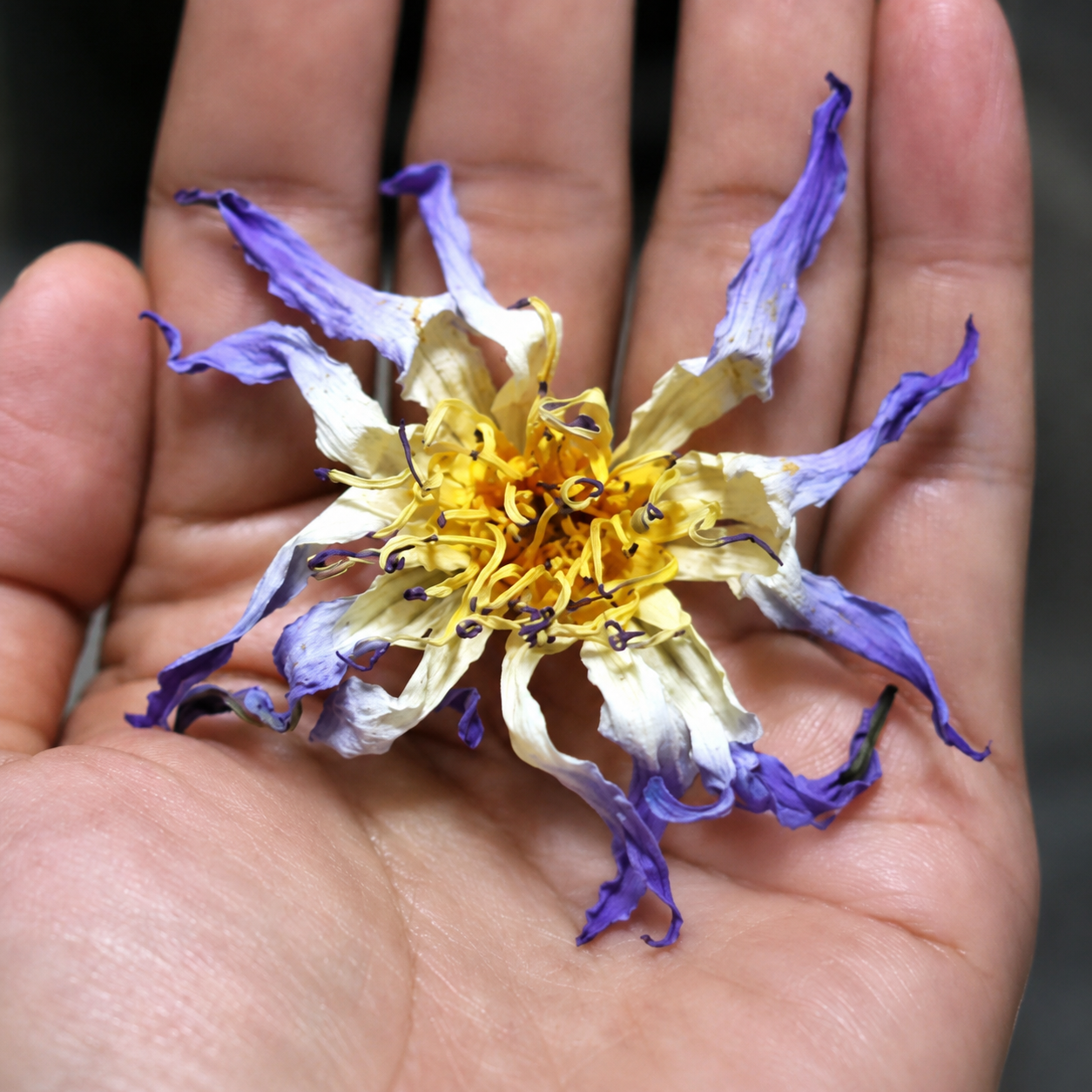
Authentic whole dried Nymphaea caerulea — the same species depicted on Egyptian temple walls and found in Tutankhamun's tomb.
Dried Nymphaea caerulea has narrow, pointed petals with muted blue-violet colouring concentrated toward the tips. The structure is open and delicate — the opposite of the broad, vivid ornamental cultivars that now dominate the market under the same name.
Full physical identification guide — how to spot authentic Nymphaea caerulea →Botanical comparison: Nymphaea caerulea vs other lotus varieties →Frequently asked
What did ancient Egyptians use Blue Lotus for?
Ancient Egyptians used Nymphaea caerulea — the Egyptian Blue Lotus — in religious ceremonies, burial rituals, and traditional preparations documented in texts like the Ebers Papyrus (c. 1550 BCE). The flower was associated with rebirth, the sun god Ra, and the god Nefertem. It appeared in tomb paintings, funerary offerings, and ritual banquets where it was held or inhaled by priests and nobility.
Was Blue Lotus found in Tutankhamun's tomb?
Yes. Preserved Nymphaea caerulea flowers were found among the burial goods in Tutankhamun's tomb, discovered by Howard Carter in 1922. The tomb dates to approximately 1323 BCE. The flowers remained structurally intact after more than three thousand years, preserved by the dry conditions of the Valley of the Kings.
What is the connection between Blue Lotus and the pineal gland?
The connection between Blue Lotus and the pineal gland is a modern spiritual interpretation, not an Egyptian anatomical claim. In Egyptian iconography, the Eye of Horus — the Wadjet — is consistently interpreted as a symbol of inner perception and appears alongside Nymphaea caerulea across four thousand years of ritual contexts: banquet scenes, funerary rites, and temple offerings. Modern spiritual traditions have linked this co-occurrence to the pineal gland, sometimes called the 'third eye' or 'inner eye.' The Egyptians did not name the pineal gland, but the flower and the symbol appear together so consistently in their sacred record that the connection has persisted into contemporary practice.
Why did Blue Lotus disappear from Egypt?
Nymphaea caerulea did not go extinct — but it disappeared from Egyptian cultivation over centuries following the decline of traditional Egyptian religion, climate change along the Nile delta, and the progressive desertification of its native habitat. The species survives today in tropical climates, including Thailand, Kenya, and parts of South Asia, where the growing conditions (warm water, full sun, humid climate) match its original Nile environment.
What is the difference between the Blue Lotus of Egypt and the Sacred Lotus?
The Egyptian Blue Lotus is Nymphaea caerulea — a water lily with narrow, pointed blue-violet petals and a documented ritual history in Ancient Egypt. The Sacred Lotus is Nelumbo nucifera — a completely different genus, common in Buddhist and Hindu traditions, with large pink or white bowl-shaped flowers. They are unrelated botanically and carry different cultural and botanical profiles. The two are frequently confused in both popular culture and the botanical supplements market.
Where is authentic Egyptian Blue Lotus grown today?
Authentic Nymphaea caerulea is cultivated today in tropical climates that replicate its original Nile conditions: Thailand, Kenya, Egypt (in small-scale revival cultivation), and parts of South Asia. The species requires warm water, full sun, and a slow, careful harvest — one flower per plant at a time. LOTHARA sources from two independent growers in Thailand, where generational knowledge of aquatic flower cultivation tends the plants through the full six-month cycle before first bloom.