
Blue Lotus Archive
Nymphaea caerulea vs other lotus varieties:
the botanical truth
"Blue Lotus" covers several unrelated aquatic plants. Only one of them is the flower the Egyptians revered. Here is a precise botanical comparison — what makes Nymphaea caerulea different, and how the most common substitutes compare on every dimension that matters.
Why "Blue Lotus" describes more than one plant
"Blue Lotus" is a common name, not a taxonomic designation. Over centuries it has been applied to several unrelated aquatic flowers that share a similar colour and growing environment. Today, a single three-word label covers plants from different species, different genera, and different continents — with different chemistry and no shared lineage.
The economic incentive reinforces the confusion. Authentic Nymphaea caerulea takes six months before its first bloom and yields one flower per plant at a time. Faster-growing other lotus varieties can produce many flowers per plant in a fraction of the time — and enter the market at commodity prices under the same popular name.
Species by species: what is actually in the market
The authentic species
Nymphaea caerulea
Egyptian Blue Lotus
Narrow pointed petals, muted blue-violet tips, open delicate structure, greenish back markings
Species-specific composition described in the botanical literature
Nymphaea nouchali
Blue water lily
Broader petals, more vivid blue, denser centre — often indistinguishable without botanical analysis
A distinct species with its own composition — outside the Egyptian ritual tradition
Nelumbo nucifera
Sacred lotus
Large bowl-shaped pink or white petals — visually distinct from Blue Lotus
Nutritional value (B vitamins, fibre, minerals) — entirely different genus from Nymphaea
Ornamental Nymphaea cultivars
Blue Capensis, Blue Spider, Blue Star, Dauben, and others
Vivid, uniform purple or blue — often rounder, denser, and more visually striking
No documented botanical identity or published composition
Five dimensions where Nymphaea caerulea stands apart
- 01
Botanical lineage
Nymphaea caerulea is a specific species with a documented 4,000-year ritual history. Most other lotus varieties sold under the same name are different species, different genera, or modern cultivars with no Egyptian lineage.
- 02
Species identity
Nymphaea caerulea is a botanically distinct species with a documented historical record. The varieties substituted for it in the market are different species or cultivars — a different flower, whatever the label says.
- 03
Cultivation rhythm
Authentic Nymphaea caerulea takes six months before its first bloom and then gives one flower at a time, every few days. Faster-growing substitute varieties can produce many flowers per plant in a fraction of the time — which is why they enter the market in such volume.
- 04
Physical appearance when dried
Authentic dried Nymphaea caerulea has narrow, pointed petals with muted blue-violet colouring concentrated toward the tips. Most substitute varieties have broader, rounder petals with stronger, more uniform colour — the "picture-perfect" blue that looks more decorative than sacred.
- 05
Price
Because authentic Nymphaea caerulea is biologically limited, it cannot honestly cost a few cents per gram. Products priced at bulk commodity rates are almost certainly other lotus varieties, regardless of the label.
Physical identification: what the authentic flower looks like dried
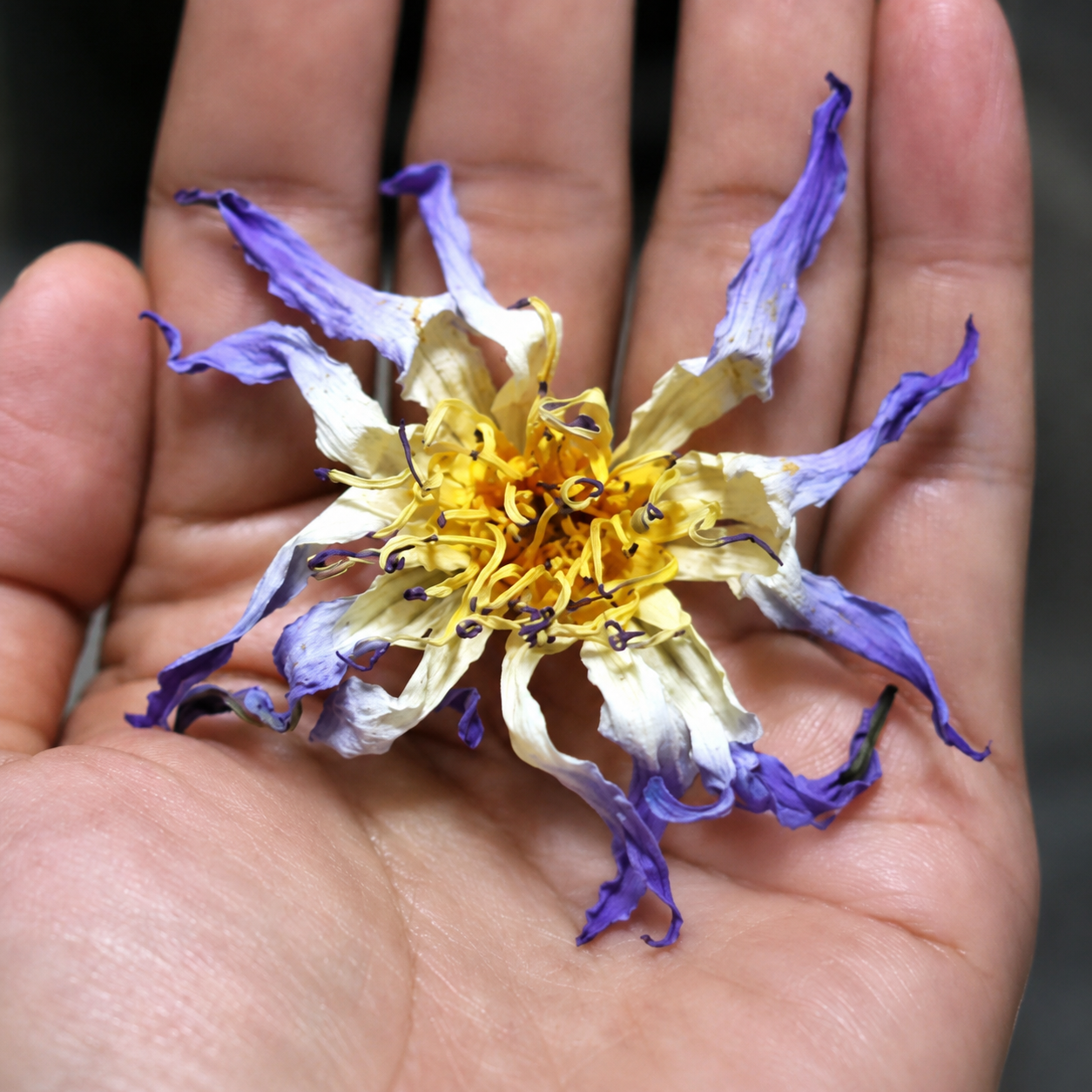
Authentic whole dried Nymphaea caerulea — narrow pointed petals, muted blue-violet tips, open structure.
Authentic dried Nymphaea caerulea has narrow, pointed petals with muted blue-violet colouring concentrated toward the tips. The stamens are sparse and golden — not the thick, fluffy centre of most ornamental cultivars. The back of the flower often shows greenish streaks or natural speckled markings. The overall structure is open, irregular, and delicate — the opposite of the uniform, vivid flowers bred for visual impact.
Read the full physical identification guide →What to look for when buying
The label "Blue Lotus" tells you nothing about species. A seller who names Nymphaea caerulea explicitly — and can explain how they verified it — is meaningfully different from one who names a category. Independent botanical analysis, a traceable single-origin farm, and whole dried flowers rather than powder are the most reliable markers.
The market sells the name. Not the flower.
See LOTHARA's verified flower →Frequently asked
What is the difference between Nymphaea caerulea and other Blue Lotus varieties?
Nymphaea caerulea is the authentic Egyptian Blue Lotus — a specific species with a 4,000-year documented ritual history. Other lotus varieties sold under the same name are different species or cultivars with different origins and no shared lineage with the Egyptian sacred tradition.
Is Nymphaea nouchali the same as Blue Lotus?
No. Nymphaea nouchali is a different species — a blue water lily native to South and Southeast Asia. It is the most common substitute sold as "Blue Lotus" in the mass market, but it is a different flower with no connection to Ancient Egyptian ritual use.
How can I tell Nymphaea caerulea from substitute varieties when buying dried flowers?
Look for narrow, pointed petals with muted blue-violet colouring toward the tips, sparse stamens with a golden centre, and greenish markings on the back of the petals. A seller who names the species explicitly as Nymphaea caerulea and can provide botanical verification is a stronger indicator than appearance alone.